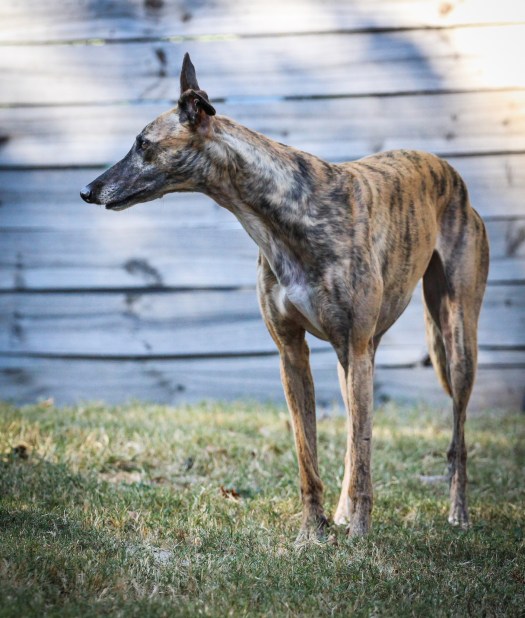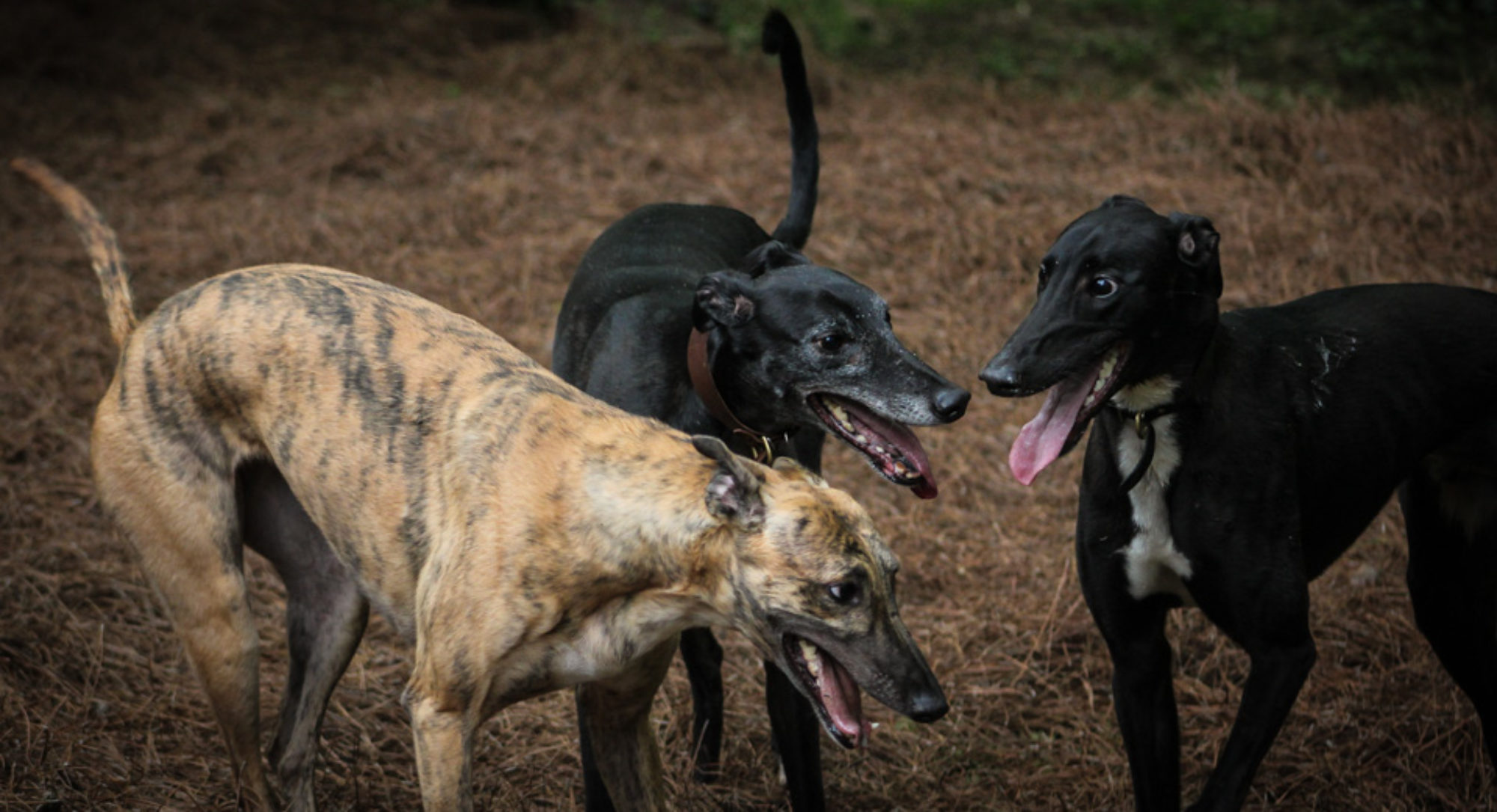
Is my Greyhound Dumb?

Have you ever tried to get your Greyhound to pay attention to you and he simply continues with his activities as usual? I have and it is annoying.

As I have mentioned, Jethro is recovering from an epidural hematoma in his back and subsequent hemi-laminectomy. Most of the time Jethro is happy and willing to participate in his recovery; other times he is not interested and has more important things to do like lie in the sun and act like a statue.
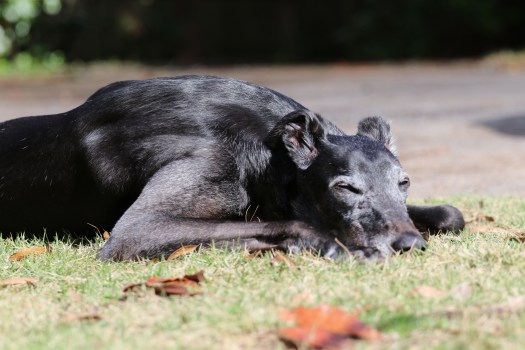
Jethro is not stupid and Greyhounds are not stupid dogs but they are not biddable.

There is a reason why Greyhounds aren’t biddable. Let’s think about the history of the Greyhound and what our racing Greyhounds are currently trained to do. Greyhounds, by way of nature and nurture, are independent thinkers. They are able to chase after something catch it and return it. They are able to position themselves on a track and successfully outmaneuver seven other dogs. The path that the Greyhound must plan to be successful requires some thinking that is not driven by a human. There is more to our Greyhounds than just raw speed!

This skills associated with racing and coursing are somewhat learned but also bred into the Greyhound. Genetics play a huge role in the Greyhound’s ability race on an oval track or course. That is not to say that training does not impact the Greyhound’s learning, but he has to have the capacity to think independently first or use his instincts.

Greyhounds are actually rather smart dogs. However, their independence can really be frustrating and create a negative environment for training or rehabbing.

So how do we make our Greyhounds as successful in rehab or training? It starts with knowing your dog and having your head in the game, so to speak!

I am a high-strung person with a touch of OCD, so I don’t do chill very well. This can be difficult when training dogs. While rehabbing Jethro I found myself very frustrated with him at times because he was not doing what I wanted and I couldn’t check that set of exercises of the list for the day. I found myself dreading his PT sessions, and I could tell that he dreaded dealing with me. After a very unsuccessful morning of trying to do PT exercises and Jethro impersonating a Greyhound statue, I knew something had to change.

Guess what, folks?  I needed to change. In the process of not completing his exercises for the day, I was becoming very nervous thinking about the possible terrible outcomes that lack of PT could lead to. I was focused on getting him better but not on Jethro or what Jethro needed in a trainer. I was a deranged anxious lady that he wanted nothing to do with; I was not his calm collected owner.

Now I make sure he is doing something daily but that can vary from increasing the time he stands, the number of sit-stand reps, or going on a 15-minute walk with Darla and Sashi.

Knowing my dog and where he is in his recovery has been essential to his improvements. Knowing your dog and where they are from day to day is essential in any type of training not just physical therapy.

Getting to know your dog opens the door for biddability. We must understand that there is more to our Greyhounds than raw speed – that big stubborn dog also has a lot of brain power.

Greyhound Anatomy: Feet

If I were asked what is the most important physical attribute of a Greyhound, without a pause my answer would be feet.

Often times we take our feet for granted forgetting that they support and balance us throughout the day. Feet are essential, just about every action we do involves our feet. One of the most important features of a Greyhound is their ability to run. So it would make sense that a Greyhound must have good feet to run through terrain after a hare or chase a mechanical lure on a sand track. Greyhounds need an exceptional base for them to perform at their best.

If you have ever studied a dog foot, it is complex structurally. There are multiple small bones that make up the carpus (wrist), foot, and toes of the Greyhound. All of these tiny bones have a purpose and even a small fracture can cause issues. In addition to the multiple bones in the Greyhound’s foot there are also ligaments that attach bone to bone and tendons that attach the Greyhound’s muscle to bone. And remember the feet need to be well innervated with nerves, sending and delivering messages between the brain and foot. It is essential that the Greyhound have excellent proprioception or know where its feet are and how to move its feet to achieve a task.

I believe that some dogs are born with superior feet. When considering breeding Greyhounds you have to weight out the pros and cons of both parents.  I am sure feet are considered as a toe or wrist injury can put a dog out of work for weeks to months. I grew up in Appalachia and one old wives tale was that a double dew clawed (dew claws on both the front and back feet) dog was a lucky dog. Dog people have always paid attention to dog’s feet.

I want to talk about a common injury that many Greyhound owners may encounter—a dislocated toe. A dislocated toe or luxation of the proximal interphalangeal joint (PIP) or distal interphalangeal joint (DIP) joint occurs when the ligaments that hold either the PIP or DIP  joints together can no longer tolerate the external stress on the joint and they give out. Generally speaking the joint will dislocate dorsally or upward. Oftentimes the joint will pop out of place and the ligaments still having integrity, will pull the luxated portion of the toe back into place. The toe will appear very swollen and sometimes will have a knife like cut where the luxation caused a break in the skin. However, the ligaments can completely lose their integrity and the joint will be displaced. Generally the Greyhound will be lame and you will be able to see the displaced toe. Often times the joint can be reset but this can be painful—I highly recommend against doing this on your own the first time unless you have experience resetting joints. In most cases with either presentation, the likelihood of the luxation recurring is high.

In addition to recurrence being high, successful treatment can be difficult to achieve as well. A trip to the vet is indicated to get an x-ray and make sure there is not a small fracture. For most pet owners the toe can be set and splinted for a week then rested for 2-4 weeks. Then pray the next time your Greyhound runs that the toe will stay in place!

Often times performance Greyhound owners will opt for intervention. Evidence for these types of procedures is variable. But certain orthopedic vets will complete the procedure and they can be very successful. Jethro severely dislocated his toe in March 2014, had stabilization with suture material in March 2014, and he continued amateur-running sports until December 2015 without any toe issues. If you were going to proceed with an intervention the vet would place a suture material or sclerotic material in the affected area to stabilize the joint then hope that the Greyhound’s inflammatory response will create arthritic changes to further stabilize the joint. If this fails amputation would be a reasonable next choice, especially for a non-weight bearing toe.

On the subject of amputation, I am not a fan or removing parts of the body that are not causing issues; however, as soon as trouble strikes and reasonable treatments have failed, remove the problem. Dogs don’t care about how many toes they have but they do care about pain!

There are also plenty of alternative methods to try in these cases. I am a believer in acupuncture, turmeric, and fatty acids (Omega QD). Some people really like a cold laser as well. I have used the cold laser many times and I feel that it does not hurt but I have not seen as much improvement with cold laser as other alternative treatments.

Greyhound feet are vital to our dog’s daily doings. Understanding the foot and where possible issues could arise is important so that you will be better prepared when an accident strikes.

The Perfect Pair

After writing my post, Yes, I Own a Racing Greyhound and No She Isn’t a Rescue, I was delighted by the support from readers and that so many readers related to my experience. This post engaged a lot of people and a lot of comments. The comments I received were very positive. However, in many of the negative comments there continued to be a theme, using old information to justify the anti-racing agenda and the idea that Greyhounds are “rescued” from inevitable death.

I have been a part of the Greyhound world for four years and the dog world since birth. My Greyhound learning curve has been steep. You could say that I am obsessed with expanding my Greyhound knowledge, if I am not out photographing my Greyhounds in a beautiful field, I am learning more about the breed and why performance is so important.

I entered the Greyhound world at a very good time. The racing industry and adoption charities had created a successful relationship with the welfare of the racing Greyhound at the forefront. It was not an easy journey and took a lot of hard work from both parties.

In the late 1980’s Greyhound racing was the sixth most popular sport in America. There were multiple tracks throughout the country and there was high demand for racing Greyhounds. Greyhound breeders were breeding and whelping to fill the demand for racing Greyhounds.

With the increase in supply of Greyhounds, there was always a newer faster dog in the wings. Unfortunately these racing kennels could not house excess Greyhounds. This was a huge issue. Greyhound adoption was catching on in the mid-1980’s but there were some obstacles. Many people opposed Greyhound adoption stating that these dogs were vicious, trained to kill, and should not be rehomed as pets. The racing industry and the adoption charities developed a symbiotic relationship, hosting meet and greets at tracks and encouraging the publicity of unmuzzled Greyhounds interacting with people. Adoption groups continued to sprout up throughout the country re-homing racing Greyhounds.

In the meantime, The AR lobbyists were trying their best to end Greyhound racing by 2000.  The racing industry continued breeding Greyhounds to the performance standard, albeit fewer Greyhounds per year.  But there was a big change, no longer were trainers having to search desperately to place retired racing Greyhounds. The racing Greyhound had an abundance of people wanting them in retirement. The improved publicity and relationship between the racing industry and adoption charities increased the adoption rate of retired racing Greyhounds to 90%.

Due to the work of adoption charities and the Greyhound racing industry, I do not feel that today’s racing Greyhound is a rescue. There is a high demand for retired racing Greyhounds as pets.  If one adoption group cannot take a dog another will. However, decades ago, when trainers were desperately searching for groups to take their Greyhounds, knowing there was no more room in their kennel, I can understand why some would refer to the Greyhound as a rescue. But times have changed.

The racing industry has a commitment to the performance standard of the Greyhound and with the assistance of adoption charities the industry has been able to further their commitment to the welfare of the racing Greyhound throughout their lives on and off the track.


A Day of Lure Coursing


Blogging can be a challenge. I get bloggers block and have trouble coming up with interesting Greyhound topics when this happens I turn to my husband for inspiration. He suggested a chronicle of a day in the country lure coursing. I thought that he was onto something. I hope that you all enjoy this post and folks who haven’t been to the field decide to come out for a day of fun in the country.

Lure coursing is a weekend event. On Friday night I begin packing the van. I feel more organized this way. To aid me in my OCD organization I bought plastic bins that are organized with first aid supplies, leashes, blankets, and other lure coursing accouterments. I have crates for all the Greyhound set up in my car. I have learned my lesson about having loose Greyhounds in the car after Jethro locked me out of the car and jumped out through the sunroof!

I leave my house with plenty of time to get to the field. I generally pick up breakfast as oftentimes I am very busy at the trial and have a hard time bringing myself to eat.

The trial begins with inspection and check-in usually around 9AM. At large trials like the International Invitational, inspection can start before the sun is up! This is when the inspection committee watches your Greyhound’s gait and checks for lameness. They also check the bitches to make sure that they are not in season.

Photo Credit: Cindy Frezon

After inspection, the field secretary completes the “draw” or the running order of the hounds. This is a blinded draw of the coursing hounds with a separate draw for each stake, open, field champions, and veterans.

While the draw is going on I usually walk my hounds. It is important to let your hound poop and pee prior to running—just ask Sashi – when nature calls, it calls.   I also like to stretch the hounds and warm them up, and the walk helps with this.

After the draw is posted the trial begins to get underway. I take a photo of the running order because I will forget—it is not fun to be at the line in the wrong blanket! I then head back to the van to get the hounds ready for their run. If the hounds are running on continuous loop I will wrap vetrap around the Greyhounds’ legs up to their stopper pad to prevent line burn. Also, if the ground is hard and dry I will tape their pads with elastikon to prevent a blown pad. When it is our turn I head to the line with my hounds in a slip lead and regular lead. I get in position, holding the slip lead with my right hand and place my left hand under the Greyhound’s tuck. Some people do not like to hold a Greyhound under the tuck but I find that it gives me more control of the dog. The lure starts to move and the Greyhounds lose their minds! The hounds are not released until the hunt-master says “Tally-Ho” when the lure is far enough in front of the dogs.

Photo Credit: Cindy Frezon

I let the Greyhound go as soon as I hear “Tally-Ho.” Then I get to watch my most favorite thing: a big beautiful Greyhound doing what they are best at, chasing.

The Greyhounds are moving so fast it seems that the entire course only lasts seconds.

Once the Greyhounds are back at the line, I grab mine and hurry back to my van to remove any tape or vetrap and check them for any lameness or tenderness. Once the vetrap is removed I use a pressurized sprayer with water to rinse out their nail beds. When dogs run on turf they can get a build-up of debris in their nail beds. This can be painful and a potential cause for infection. If there is a little blood in the nail bed, that is okay and it should be cleaned with the sprayer. I do not give water at this time. After they appear to be sound I walk them until their breathing becomes more normal and they are able to close their mouths. Then give them a small amount of water.

Photo Credit: Cindy Frezon

After all the dogs have ran in prelims the entire process is repeated, generally after lunch, which gives a nice break for the hounds. Once all dogs have run twice, the top hounds will run for best of breed. After best of breed is completed, all the breed winners are able to run for best in field.

Once all the running has been completed, awards are given out and photos of the winners are taken. Most often the placing dogs will get a toy (my hounds are very pleased with this).

After socializing with friends and some photos, we pack it up, head home, ready to repeat the following day.


Feature image credit: Cindy Frezon

Separation Anxiety

A lot of my blog ideas come from previous posts.  I do research on a topic and then think about my experiences.  I think that gives this blog a distinct feel and I hope you all enjoy it as well.  The other day I way touching on some of the myths people believe about racing Greyhounds and their lives on the track.  Separation anxiety popped into my mind.  In addition to hearing that skittish dogs are products of abuse, I have also heard and read that the anxieties or issues Greyhounds have in their adopted homes are products of what might have happened at racing kennels.

Today I want to dive into my dogs’ separation anxiety (SA) journey and how it correlated to mistakes I made and not problems in their kennel lives or mistreatment.

In my “Myths Busted” post I compared a racing kennel to a military school.  I think this is the most accurate way for many adopters to understand their Greyhound’s previous life if the adopter has never been to a kennel or racetrack.  Dogs are creatures of habit and, due to that tendency, Greyhounds do very well in the racing kennel environment.  Kennels have daily routines that do not differ greatly from day to day.  This is very comfortable living for most dogs. Once the decision has been made to retire a racing Greyhound and send them to an adoption kennel, their lives change but generally speaking they continue with a stable routine.  Sometimes the retired Greyhounds have a long trip to the adoption kennels but once there the Greyhounds enjoy a routine that includes exercise, interactions with humans and Greyhounds, and meals.

The big change comes to the Greyhounds’ routine when they are adopted.  One change is they are no longer around other Greyhounds (unless there are Greyhounds in their new family).  These dogs have spent their entire lives with other Greyhounds and are now alone. They may also have more free time—they can wander around in the yard or house.  They most likely are getting less exercise than previously, possibly increasing their anxiety.  Finally the biggest change and the biggest issue is the over-abundance of affection from their new owner(s).

All of these changes influence the risk of separation anxiety in these dogs, but the biggest issue is the amount of affection we give to our newly adopted Greyhounds.

When Clint and I adopted Jethro I had firm opinions that Jethro was going to be crated and sleep in our sunroom that was close to out bedroom but not in it.  Big mistake!  The first few nights Jethro howled and I went into the sunroom every time to comfort him.  This was my first mistake and biggest mistake.  It would have been better for Jethro to be crated in our room than for me to continue to check on him.  I know this is what triggered his separation anxiety. And it was not easy to undo.

Jethro had horrible SA.  He chewed through multiple metal and soft crates, escaped through the sunroof of my SUV at a field trial, escaped from a kennel run with a d-ring, he learned how to break down a metal crate and would leave the front panel off to chew up our window seal and blinds.  I felt that I had created a monster!  I had no clue how to help him.  I consulted my friend Jennifer Bachelor and her blog.  By this time it was clear that the crate was not working for Jethro.  We began baby gating Jethro in the kitchen—we could make his area smaller than a bedroom but larger than a bathroom. We continued to leave the TV on for him and a kong.  We also hired a dog walker to check on him.  And we got another Greyhound.

The process of Jethro’s SA rehab took a long time.  He is still not a fan of the crate but deals with it for car rides and field trials.  He does have the run of the house when we are away.  I do NOT feel that Darla’s arrival fixed his issues, but it did help.  I would not recommend getting another dog to fix SA, as you have to deal the dogs’ issues and training issues, getting him stable before adding to the pack—I would have lost my mind if I had two dogs like Jethro!

After my experience with Jethro, I looked at Darla’s arrival completely different.  If I was home and not playing or training Darla, she was crated.  I made the crate fun—she got raw bones, feet, and hooves that she was not allowed out of her crate.  She slept on a dog bed in my room.  I did NOT shower her with affection: she had to earn it.  Darla and I had a “working relationship” for about a year.  It seemed like she respected me for giving her stability and security and over time we developed a relationship of best friends.  I do not regret one aspect of Darla’s training and she is a very balanced Greyhound and extremely secure.  Sashi was also trained in this manner—he likes his crate so much that he will hang out in there when we are home!

You can have too much of a good thing.  We have to remember that saying when adopting our Greyhounds.  We have to focus on a routine that we set and they live by.  We must exercise and train our Greyhounds—just because they lie around does not mean they do not need stimulation!  And we have to remember that affection will come but security is much more important and what we should strive for.


Yes, I own a racing Greyhound and no she isn’t a rescue

Am I the only Greyhound owner who gets annoyed when asked if my Greyhound was rescued?  It really gets under my skin and it seems to happen far too often.  The other day we were buying dog food and I was asked if my Greyhound was “rescued.”  I was in a particularly rotten mood and my husband elbowed me as to say “please do not unleash your bad mood on this poor kid.”  I put my bad mood aside and replied, “No, they were not rescued and yes they are racing Greyhounds.”  The kid looked perplexed but continued to bag our goods and not ask for more clarification.

I feel continually frustrated about the misinformation that makes its way into the mainstream.  It seems like the anti-racing (AR) propaganda penetrates so deeply that it has affected many people, even people who own Greyhounds.

This past week I read two articles in two different papers in North America stating complete inaccuracies about Greyhound racing and the lives of racing Greyhounds.  By no means am I saying there are no failings in the Greyhound racing industry and that it is perfect.  However, I feel that the vast majority of people working in the Greyhound racing industry love Greyhounds and respect the breed for what it is: a functional, fast, exceptional hound.

If you are into Greyhound adoption and have not visited a track, you’re missing out.  I am lucky to be a part of a Greyhound Adoption group that arranges yearly visits to racing kennels and tracks encouraging adopters to see what life was like for their Greyhound before adoption.

It is important to be thoughtful about our opinions, and knowing the details of both sides is important to understand the entirety of a subject.   Unfortunately, it seems that most of the AR supporters cannot see past outdated reports of abuse and neglect to see the positive changes in Greyhound racing today. It oftentimes seems overwhelming to educate the general public and some Greyhound enthusiasts that racing Greyhounds are loved, well exercised, well fed and happy in their professional careers.

There are certain ideas created and propagated by the AR machine about retired racing Greyhounds that have invaded mainstream Greyhound adoption.  One idea is that skittish dogs were abused throughout their professional careers.  This idea is complete rubbish.  First off, by now we all know that negative training is not successful.  Why would someone spend thousands of dollars on a dog that could create revenue and abuse it, thus diminishing their chances of success? Complete insanity.  Furthermore, dogs have different personalities just like us.  I have raised a fair number of terrier pups and for the most part they are fearless dogs, but I have seen dogs be gun shy or timid with no external cause for them to demonstrate that behavior.  Skittish Greyhounds are most likely that way do to nature not nurture.

Another idea that makes me nuts is the raw meat myth.  Feeding raw meat is not a bad thing!  Dogs are predators and they are made to eat raw meat.  Now, let’s talk about non-human grade meat.  The labeling of meat is not just based on the quality of the product but also the facility it is made it.  Lots meat packing facilities have quality products but have not obtained certification from the USDA to mark their product as “human grade.”  Most pet foods are not made for human consumption, as the regulations and certification for this labeling would be very expensive, increasing the cost of pet food.  It’s just not a logical business move. Thus, the non-human grade meat myth should be a moot point from now on.

Opinions and facts are not the same; however, opinions create gut responses and bias.  When dredging through the misinformation about Greyhound racing it is important to push our bias aside and get at the truth.  I support Greyhound racing for many reasons and as I have seen and learned more about the industry my support grows.  I hope that this article encourages you to reinvestigate your feelings about Greyhound racing immersing yourself in facts and not opinions.